review oukitel k 6000
Design
Oukitel K6000
Starting from the top-front of the phone, you have a front-facing camera and proximity sensor respectively flanking the speaker grill which sits dead in the middle. Below that is a 720p 5.5" display, and below that is the standard three-button Android cluster of buttons. The entire display is 2.5D glass, meaning the screen doesn't square off and is extremely similar to the way the iPhone 6's display is.
On the right side of the phone there is a volume rocker and the on/off button directly below that. The rear cover isn't removable, which means that you have to insert the SIM-card via a pin-release tray on the left side of the phone (on the bezel), which is again somewhat similar to the iPhone. Speaking of the back, though, the back of the phone has a camera with a dual-LED flash to it's right, followed by an aluminum piece that takes up most of the span of the rear housing, and it only stops to make way for the plastic rear-speaker grill at the bottom. At the very top side of the bezel there is a 3.5mm audio port.

Oukitel K10000
The Oukitel K10000 is a beast. Seriously, trying to explain how this thing looks is pretty tough, so I'll hope the photos do more justice than what I can put into words.
The Oukitel K10000 isn't a square with round borders, rather it has somewhat of an octagonal shape. Starting from the top we have the speaker grill and proximity sensor in the bezel, and below that to the right we have the front-facing camera. The phone has a 5.5" 720p display which also happens to be 2.5D, although not as pronounced as it is on the K6000, nor as visible, due to the way the bezel curls over the screen. Below the display is, again, the standard Android three-button cluster.
The sides of the phone are very similar to that of the K6000 in that the right-hand side has a power button followed by the volume rocker, the left-hand side has the pin-release SIM-card tray, and the top bearing a 3.5mm audio port and a micro-USB port at the bottom. In the case of the Oukitel K10000, however, there is no speaker grill on the back, instead, the speaker grills flank the micro-USB port at the bottom.
The rear of the phone has a dual-LED flash to the left of the rear camera (which has its own bezel). This is followed by a sheet of aluminum with a geometric bull's head as a separately-bezeled independent feature in the middle of the phone, which what appears to be rivets holding this aluminum plate on. Speaking of rivets, however, they seem to be holding the whole phone together and can be found everywhere around the phone. Whether this was actually how the phone is held together or if it's just eye candy isn't very clear, though.

Both of the phone's weight and heft should be discussed: the Oukitel K6000 is markedly heavier than most phones you'd pick up in 2016. The battery it's packing is at least a third, and as much as twice or more than that of other phones and it's clear that compromises were made when it came to weight. That said, it's still comfortable to hold and use and I would have no issue with using it as a daily driver.
With the Oukitel K10000, however... it really is a beast of a phone. It's so heavy that it could easily double as a weapon, it's about 1.5 cm (0.6 inch) thick and it really isn't the type of phone you'd want to hold over your face when using your phone while lying in bed (no really - i'm talking from experience here).
Display
The phones both come with a 5.5" 720p panel because of the intended purpose: battery life. A 1080p panel consumes significantly more power than a 720p panel of the same tech, so Oukitel made the choice to sport a 720p display, and I can easily support it. The displays on both the phones still look great, and this really isn't a phone that is intended to be spec-focused as much as it's intended to be battery-focused.

Build Quality
Oukitel K6000
I can't fault the Oukitel K6000 for much, but the power button more or less fell apart inside the phone after just a week or so of use. What I mean by this is that it became incredibly hard to press - so hard that it made using the phone a nuisance. Every time I go to turn the screen on or off I'm reminded of how difficult it is to do, and it's not something you get use to. It's also not something that Oukitel intended, given that it was something that happened after a week's worth of use rather than having it come out of the box like that. I hope it was a one-off for me and not a common issue because it seems like a terrible Q/A oversight for something so crucial to the use of the phone.
Another issue is that I actually managed to completely destroy the screen after dropping it from about one to one and a half feet from my lap and onto the pavement. It wasn't a very high fall at all and while the glass didn't appear to be terribly damaged (it did have one sharp break going through half the phone, but that's it), the touch sensor was no longer functioning for everything below the aforementioned crack in the display. I've dropped other phones from higher places without issue, so it was disappointing to see the phone become unusable with what was something pretty minor.
Oukitel K10000
Argh... how do I even begin. This isn't a phone, it's a transformer posing as a phone. I honestly believe I can tie this phone to some rope and use it as a ball and chain, and it will still be working after I pillage a town or two with it. Holding the phone doesn't feel like you're holding a phone, with so much metal and rivets and... I don't know, all I can say is that the phone is extremely well built. I haven't had any issues with it at all, such as what I experienced with the K6000's power button, and I did drop it while camping at one point and it barely got a scratch on it. It's really well built.

Performance
Both phones have the MT6735 which is a 64-bit quad-core SoC clocked at 1.0 Ghz. It clearly isn't intended to break records, at least not for computation performance, but again the phones were designed around battery life and this was the perfect SoC for that.


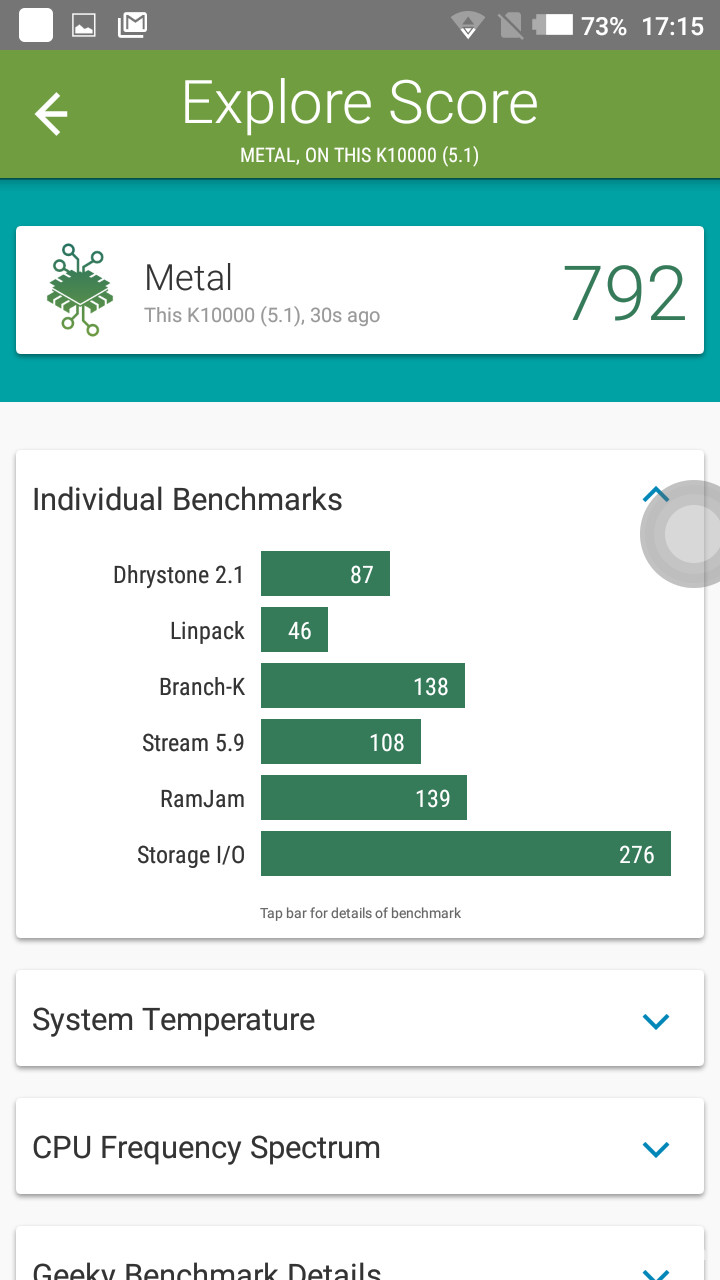

Because both phones have basically exactly the same spec, they got almost exactly the same benchmark scores, so I'll only be posting the one set of images above. It's worth noting that both of the phones will get roughly exactly the same score, with fluctuations of +/- 10 points depending on variables like temperature, or simply luck at the time of benchmarking.
Specifications
The two phones have identical specifications with the only difference being the battery size.
| Display | 5.5 inch 720p (2.5D) |
| CPU | MTK6735 64bit Quad Core 1.0GHz |
| GPU | Mali-T720 |
| OS | Android 5.1 Lollipop |
| RAM & Storage | 2GB RAM & 16GB storage, SD expandable |
| Camera | Rear camera 8.0MP (13.0MP interpolation) with flashlight, front camera 2.0MP (5MP interpolation) |
| Sensor | Gravity sensor, Proximity sensor, Light sensor |
| Bluetooth | 4.0 |
| Features | GPS, GPRS, OTG |
| SIM Card | Dual SIM dual standby, Dual Micro SIM |
| Network Bands | |
| 2G | GSM 850/900/1800/1900MHz |
| 3G | WCDMA 900/2100MHz |
| 4G | FDD-LTE 800/1800/2100/2600MHz |
review oukitel k 6000
![review oukitel k 6000]() Reviewed by lemrani
on
2:40 م
Rating:
Reviewed by lemrani
on
2:40 م
Rating:
ليست هناك تعليقات